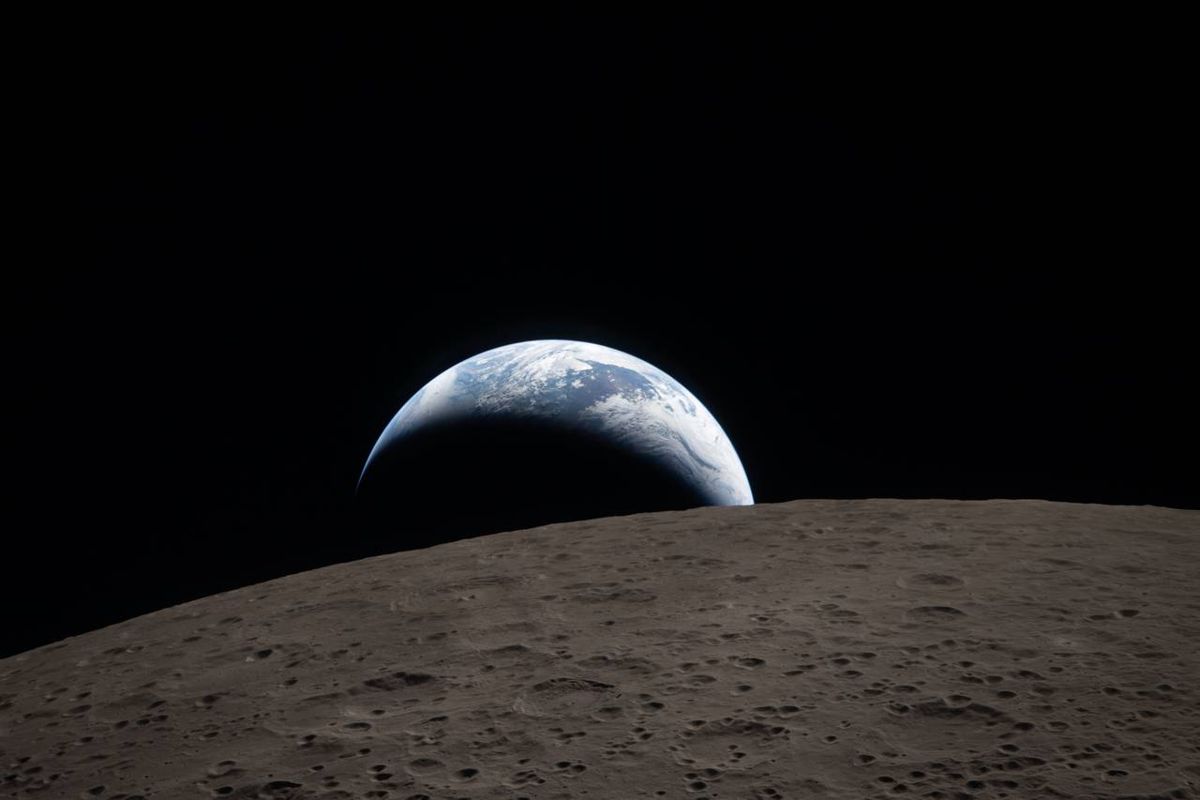
inside — an absolutely readable system.
What handled the connection?
The signal to and from the spacecraft traveled through the Deep Space Network —
a global network of radio telescopes designed by NASA for communicating with spacecraft in deep space.
The logic is simple — not maximum quality, but guaranteed delivery. Everything else works within the constraints of the available channel.
From the stream, it was immediately obvious that video was not a priority: the channel is limited, and the system adapts to conditions.
Camera placement — no surprises. Not "what looks good," but "what works and doesn't interfere with the system."
Beyond that, it's a matter of direction — but the engineering base is solid.
Moments when the transmission dropped looked maximally honest.
No channel — no signal.
It's also worth noting how the stream appeared on NASA's YouTube side.
That was also quite telling:
clean graphics without overload; persistent data (velocity, distance, mission status); seamless switching between sources; supersources; studio segments that filled the gaps in the signal.
No "wow-design." Everything is subordinate to the task — not to interfere with perception and maintain context.
According to some reports, NASA is already testing optical communication. But it's worth noting that the base system remains; new technologies are being added carefully and without calculation that any one of them will replace everything.
One thing reads very well in this ephemeris: the entire system was initially built not to fight limitations, but to work with them.
Therefore, where there is resource — imagery and detail appear. Where there is none — the system doesn't break down; behavior remains predictable.
And this, perhaps, is the most difficult level — when the result depends not on luck, but on how everything was engineered in advance.